


Most of the women I work with are already doing what is “supposed” to support weight loss. They walk regularly, strength train, stay consistent, and eat well.
However, fat loss still feels harder than it used to. If this sounds familiar, the issue is likely not effort. In midlife, weight loss resistance is rarely a discipline issue; rather, it is a signaling issue.
One of the most overlooked signals affecting metabolism is your breathing pattern. In fact, it plays a more foundational role than many realize.
Why Weight Loss Feels Different in Midlife
During perimenopause and menopause, the body becomes more sensitive to stress, while hormonal buffering declines. Consequently, this shifts how metabolism responds to daily inputs.
Metabolism is not driven by food and exercise alone. In addition, several other factors influence it:
- Oxygen delivery
- Nervous system regulation
- Blood sugar stability
- Mitochondrial energy production
All of these systems are directly influenced by something performed about 20,000 times per day: breathing. While food provides the fuel, breathing helps determine whether that fuel is burned for energy or stored.
Therefore, breathwork for midlife weight loss serves as more than a relaxation tool; it acts as a foundational metabolic input.
5 Ways Breathwork Supports Midlife Weight Loss
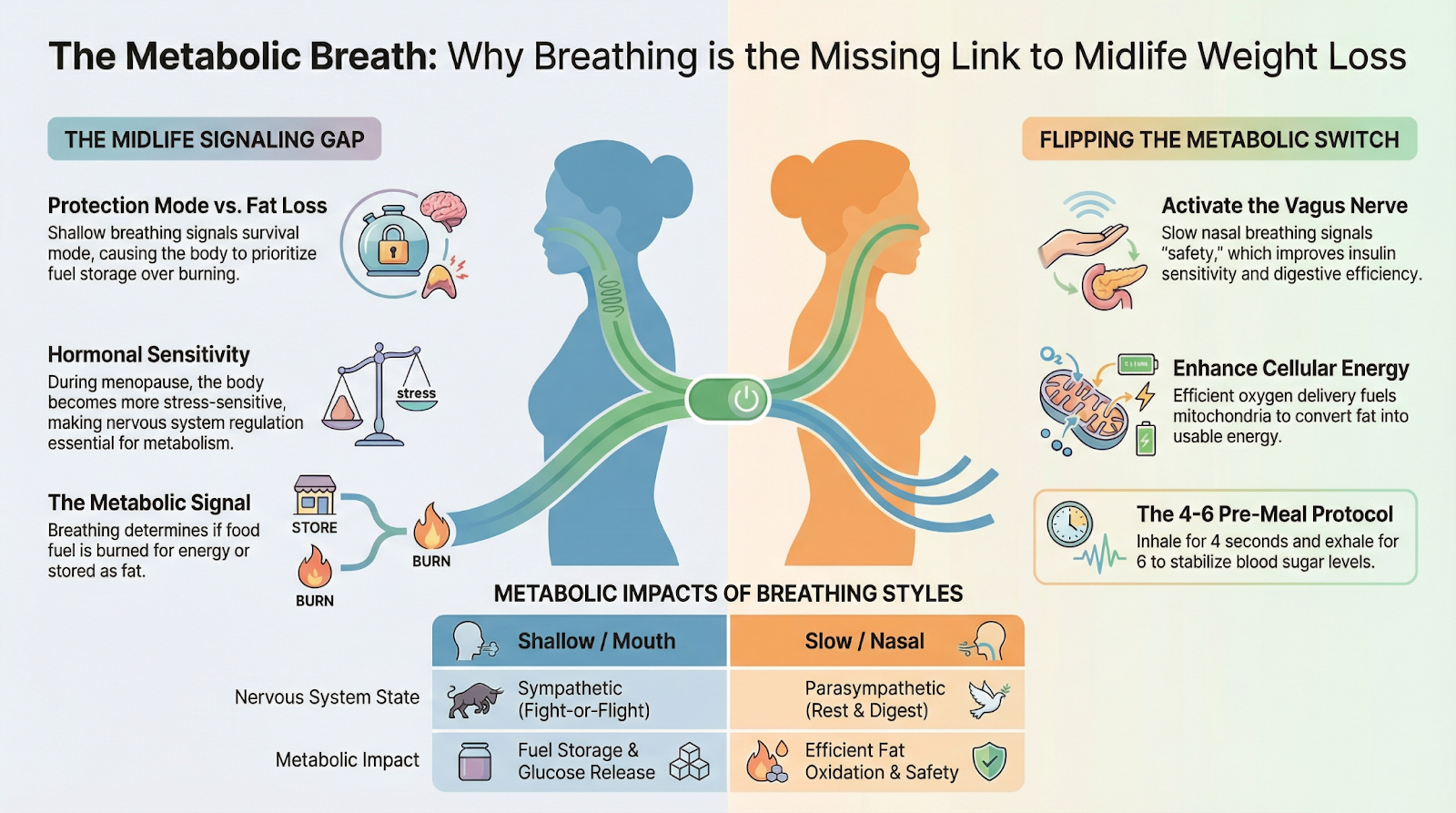
Your breathing pattern influences fat loss through several physiologic pathways. For example, when breathing is shallow, fast, or stress-driven, the body shifts into protection mode. Conversely, when breathing is slow, nasal, and diaphragmatic, the body shifts toward repair and fat burning.
This becomes especially important in midlife, when metabolic flexibility naturally declines. Therefore, understanding your breathing can directly impact your fat loss journey.
1. Nervous System Regulation: Safety Before Fat Loss
Your metabolism listens to your nervous system. Specifically, shallow chest breathing and habitual mouth breathing signal urgency to the brain. As a result, this activates the sympathetic nervous system, also known as fight-or-flight mode. In this state, the body prioritizes survival and fuel storage.
On the other hand, slow nasal breathing with a longer exhale activates the parasympathetic nervous system through the vagus nerve. In this state:
- Insulin signaling improves
- Digestion activates
- Fat oxidation becomes more efficient
Therefore, if your body does not feel safe, it will not prioritize fat loss. Consequently, breathwork helps create that sense of internal safety.
2. Carbon Dioxide Tolerance and Oxygen Delivery
It is not enough to simply breathe more oxygen; your body must also deliver oxygen into your cells effectively.
In fact, carbon dioxide plays a key role in helping oxygen detach from hemoglobin and enter tissues. However, chronic over-breathing lowers carbon dioxide levels, which can reduce oxygen delivery even if you are breathing frequently.
When oxygen delivery improves, many women notice:
- Better fat burning during walking
- Improved endurance
- Greater metabolic efficiency
Therefore, nasal breathing during low-intensity movement supports midlife metabolism effectively.
3. Better Blood Sugar Regulation
Breathing patterns directly affect blood sugar. Specifically, fast, stress-driven breathing signals the liver to release stored glucose. Over time, this can cause:
- Blood sugar swings
- Cravings
- Energy crashes
- Increased abdominal fat storage
A simple way to support glucose control is pre-meal breathing:
Inhale through the nose for 4 seconds.
Exhale slowly for 6 seconds.
Repeat for 2 to 3 minutes before eating.
This prepares the digestive system and, as a result, supports more stable blood sugar after meals.
4. Lymphatic Flow and Fluid Retention
Your diaphragm is not just a breathing muscle. In fact, it acts like an internal pump for:
- Lymphatic circulation
- Venous return
- Movement of inflammatory byproducts
However, shallow breathing reduces the efficiency of this internal pumping system, which can result in:
- Puffiness
- Fluid retention
- A sensation of inflammation that mimics weight gain
Conversely, full rib cage and diaphragmatic breathing improve internal flow and create a metabolic environment that supports fat loss.
5. Mitochondrial Energy Production
Inside your cells are tiny energy factories called mitochondria. They use oxygen to convert fat and glucose into usable energy. Consequently, when oxygen delivery is low:
- Energy production drops
- Daily movement declines
- Fat oxidation slows
This is why simply eating less and exercising more can backfire in midlife. Without adequate cellular energy, the body cannot respond efficiently.
On the other hand, when breathing improves, energy often rises naturally. Therefore, when energy rises, metabolism tends to follow.
Signs Your Breathing May Be Affecting Your Weight Loss
- Weight-loss resistance
- Fatigue
- Cravings
- Blood sugar fluctuations
- Poor sleep
Therefore, it may be worth examining your breathing pattern before tightening your diet or increasing exercise intensity. Your body is adapting, not malfunctioning, and it is responding to the signals it receives.
Simple Breathwork Practices to Support Midlife Weight Loss
Start small, because consistency matters more than intensity. For example:
- Breathe through your nose during the day and while walking
- Use a 4-second inhale and 6-second exhale rhythm
- Practice 5 minutes of diaphragmatic breathing before bed
Over time, these small changes can create meaningful metabolic shifts. In other words, breathwork for midlife weight loss is not about doing more; it is about signaling differently.
Final Thoughts
Midlife weight loss is not about forcing your body to comply. Instead, it is about creating a body that feels safe, oxygenated, and energized at the cellular level. Consequently, when your nervous system calms and oxygen delivery improves, fat loss becomes a response rather than a fight.
Breathe slowly. Breathe through your nose. Breathe into your ribs and belly. In fact, your metabolism is listening.
If you’re tired of feeling stuck and want support implementing these tools, I’d love to help.
Scientific References
Abu-Hijleh, M. F., Habbal, O. A., & Moqattash, S. T. (1995). The role of the diaphragm in lymphatic absorption from the peritoneal cavity. Journal of Anatomy, 187(Pt 1), 111–118.
[PubMed]
Hamasaki, H. (2020). Effects of diaphragmatic breathing on health: A narrative review. Medicines, 7(10), 65.
[DOI]
[PubMed]
Lundberg, J. O., Weitzberg, E., Lundberg, J. M., & Alving, K. (1996). Inhalation of nasally derived nitric oxide modulates pulmonary function in humans. Acta Physiologica Scandinavica, 158(4), 343–347.
[DOI]
[PubMed]
Martarelli, D., Cocchioni, M., Scuri, S., & Pompei, P. (2011). Diaphragmatic breathing reduces postprandial oxidative stress. Journal of Alternative and Complementary Medicine, 17(7), 623–628.
[DOI]
[PubMed]


+ show Comments
- Hide Comments
add a comment