


When “Normal” Doesn’t Match How You Feel
You’ve been to four doctors. Maybe more. Every one has run the standard panel, looked at the numbers, and told you the same thing: “Everything looks normal.”
But you know it isn’t.
You’re exhausted in a way sleep doesn’t fix. Your joints ache for no clear reason. Your brain feels foggy. Your digestion is unpredictable. Your skin has changed. Your cycle feels off. Your moods swing more easily than they used to.
You’ve been told it’s stress. Aging. Anxiety. “Just being a busy woman.”
You are not
making this up.
There is real science behind what you’ve been feeling, and it is changing how we think about autoimmune disease.
The Research That Changes Everything
In 2007, immunologist Dr. Abner Notkins made a quiet but radical prediction in Scientific American. One day, he wrote, a simple blood test would be able to tell a doctor whether a patient was “brewing” a disease and roughly how soon symptoms would appear.
That prediction has aged remarkably well.
Four years earlier, Dr. Melissa Arbuckle published a landmark study in the New England Journal of Medicine that support this idea. Working with the U.S. military’s vast archive of frozen blood samples, where service members get blood drawn routinely and unused samples are stored for years, she identified 130 patients who had been diagnosed with lupus and analyzed stored blood taken from up to nine years before diagnosis.
What she found was extraordinary.
In 88% of those patients, 115 out of 130,
at least one lupus-associated autoantibody was already present
BEFORE THEY WERE EVER DIAGNOSED.
The earliest antibodies appeared up to 9.4 years before the first symptoms. On average, antibodies had been climbing for 3.3 years before symptoms even began. Symptoms developed years later, and diagnosis still lagged by an average of another six months. So when did those patients actually get lupus? Years before anyone knew.
Why Your Standard Labs Look “Normal”
The conventional autoimmune workup, the lab markers your primary care doctor likely ran, is designed to confirm a diagnosis. It looks for elevated markers that suggest disease is already established and tissue damage may already be underway. These are the standard-of-care tests most conventional medical systems and insurance plans typically cover because they are primarily intended to diagnose active disease, not necessarily identify earlier immune dysfunction or subtle early shifts in immune activity.
A basic ANA (antinuclear antibody), a single TPO antibody, a CRP inflammation marker, these are useful but blunt instruments. They tend to flag a problem only when it has been quietly building for years and is now loud enough to spill into a standard reference range.
This is why so many women come to me year after year with thick folders of “normal” labs and bodies that clearly are not.
What You Can Actually Test for Now
The good news: researchers have dramatically advanced testing over the last decade. Specialty labs now offer panels that can identify immune reactivity patterns, tissue-specific antibodies, and potential triggers long before doctors make a conventional diagnosis, when there is often the greatest opportunity to identify potential triggers, reduce immune burden, and support the body before more significant dysfunction develops.
The two I most often run with clients to screen for potential autoimmune issues:
-
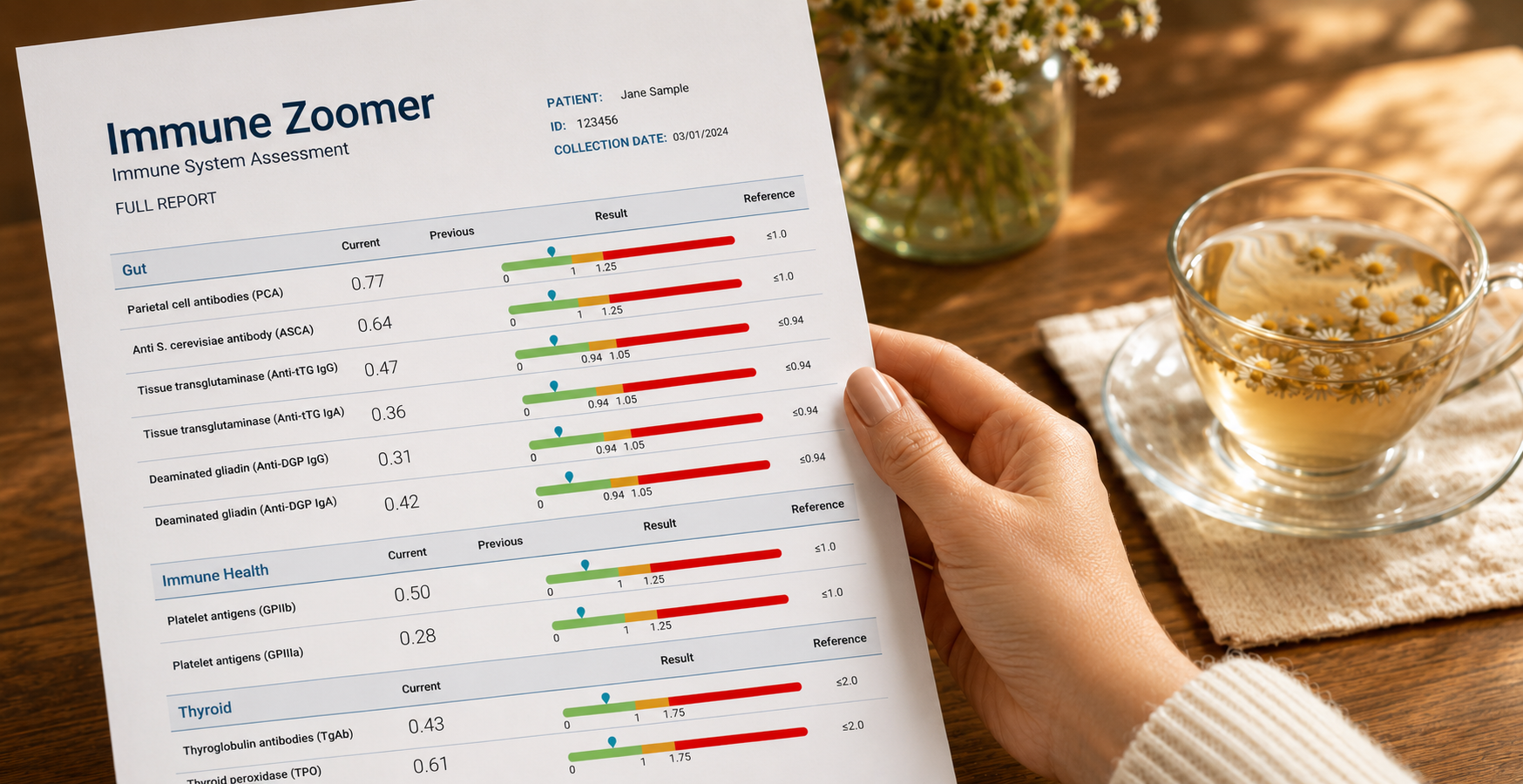
Vibrant Wellness Immune Zoomer
A comprehensive panel that screens 60+ antibodies against multiple tissue types, hidden infections, food and chemical triggers, and immune regulators, all in one blood draw. One of the most thorough early-detection panels currently available. -
Cyrex Array 5: Multiple Autoimmune Reactivity Screen
Measures predictive autoantibodies against 24 different tissues including the thyroid, joints, brain, pancreas, gut, and reproductive organs. Designed specifically to identify autoimmunity years before clinical disease.
Depending on your symptom pattern, these tests are often pair with:
-
Wheat Zoomer
Screens for two major autoimmune triggers, gluten and lipopolysaccharides (LPS), as well as pathogenic intestinal permeability, often considered a gateway to autoimmune disease. -
A Comprehensive Stool Analysis
Evaluates dysbiosis, hidden infections, and parasites. -
Mycotoxin and/or Environmental Toxin Panels
Recommended when mold or chemical exposure is suspected.
The right tests for you depend on your specific symptom pattern, your history, and what your body is whispering, speaking, or shouting.
What This Means for You
If you have been told your labs are normal but you know something still feels off, you are likely right.
Autoimmunity is now the third most common category of chronic illness in the United States. An estimated 50 million Americans are affected, and roughly 80 percent are women.
Researchers believe millions more may have undiagnosed or preclinical autoimmune activity that has not yet progressed enough to be formally diagnosed.
The average woman with an autoimmune condition sees four to five different providers and waits years for a diagnosis. Many never receive one, because the standard workup was not designed to catch them in the years when their body was first asking for help.
You do not have to wait until symptoms become debilitating before looking deeper.
You do not have to accept “normal” as the final answer.

Book Your Complimentary
20-Minute Strategy Session
If this sounds like your experience, dismissed labs, persistent symptoms, and no clear answers, you are invited to a complimentary 20-minute strategy session.
Together, we’ll review your symptoms, discuss appropriate testing, and map out next steps based on your unique case.
Michelle Ross, MS, MA, CNS, LDN, IFMCP
Board-certified, licensed nutritionist and Certified Functional Medicine practitioner. For 15+ years, Michelle has helped clients move beyond symptom management and address the true root causes of autoimmunity, fatigue, and chronic inflammation.
References
- Notkins AL. New predictors of disease. Scientific American. 2007. Read study
- Arbuckle MR et al. Development of autoantibodies before the clinical onset of systemic lupus erythematosus. New England Journal of Medicine. 2003. Read study
Frequently Asked Questions
Are these tests covered by insurance?
Generally, specialty autoimmune panels such as the Vibrant Wellness Immune Zoomer and Cyrex Laboratories Array 5 are not covered by most insurance plans. In many cases, however, they can be purchased using HSA or FSA funds. These tests are typically categorized as functional, preventive, or investigational rather than standard diagnostic testing. As a result, insurance companies often do not reimburse for them. Costs vary depending on the lab and panel selected, but many clients feel that identifying potential immune patterns, food-related immune reactivity, or early dysfunction sooner rather than later ultimately saves both money and quality of life compared to years of unresolved symptoms, repeated appointments, and trial-and-error approaches.
Why are these tests not commonly used in conventional medicine?
Many of the individual antibody markers included on panels such as the Vibrant Wellness Immune Zoomer and Cyrex Laboratories Array 5 can technically be ordered through conventional laboratories like Quest Diagnostics or Labcorp. The challenge is that ordering this many markers individually is often impractical and extremely expensive, especially since insurance typically does not cover broad predictive or preventative antibody screening. In many cases, running a large number of separate antibody tests through conventional channels could cost thousand of dollars out of pocket. Conventional medicine is also largely designed around diagnosing established disease rather than identifying earlier immune patterns or subtle dysfunction before clear diagnostic criteria are met. Most physicians are trained to order a smaller set of standard autoimmune markers once symptoms become more advanced or tissue damage is already suspected. Functional and integrative practitioners often use broader panels to look for patterns, immune reactivity, and potential contributors earlier in the process, with the goal of supporting the body before more significant dysfunction develops.
What if I don’t have a diagnosis yet, is this still worth doing?
This is exactly when this testing is most valuable. Research shows autoantibodies can appear up to 9.4 years before a person develops symptoms of an autoimmune condition. If you are experiencing unexplained fatigue, brain fog, joint pain, skin issues, digestive problems, or hormone disruption, identifying patterns now gives you the most opportunity to reduce immune burden and support the body.
I already have an autoimmune diagnosis, is this still relevant?
Yes. These predictive panels can still be highly relevant for people who already have a diagnosed autoimmune condition, especially if new or unexplained symptoms are beginning to appear. Research consistently shows that once one autoimmune disease is present, the likelihood of developing additional autoimmune conditions increases significantly over time. Panels such as the Immune Zoomer and Array 5 are designed to look at a broader range of immune reactivity patterns and may help identify whether the immune system is reacting to additional tissues or organs beyond the original diagnosis. This can provide a more comprehensive view of immune activity and help guide a broader, root-cause-focused approach rather than addressing each condition in isolation.
How do I actually get these tests done?
These are practitioner-ordered tests, which means they must be ordered through a licensed healthcare practitioner registered with the laboratory. Ideally, you want to work with a practitioner who is experienced in functional or integrative medicine and understands how to interpret these types of panels within the context of your full clinical picture, including symptoms, health history, lifestyle factors, and other lab findings. The goal is not simply to generate data, but to translate the findings into a clear, personalized plan that may include nutrition, lifestyle, supplement, or additional testing recommendations. This is something we can discuss further during a complimentary 20-minute strategy session
Disclaimer: This content is for educational purposes only and does not constitute medical advice. Please consult your healthcare provider before making changes to testing, diet, or treatment. These statements have not been evaluated by the Food and Drug Administration.


+ show Comments
- Hide Comments
add a comment